Here is an uncomfortable number for a Monday.
89% of companies say their entire approach to AI is “learning as we go.”
Not a strategy. Not a policy. Just vibes and hope. That stat comes from a 2026 survey of a thousand businesses, and if you run a small shop, you already know it is true, because it is probably true of you.
That is not a knock. AI showed up faster than anyone’s playbook. But “figuring it out as we go” has a cost, and the bill is starting to land.
In the first quarter of this year alone, courts handed out 145,000 dollars in sanctions to lawyers who filed AI-written documents full of made-up cases. The courts named the attorneys, not the chatbot. One retailer ate a 25% spike in returns because AI-generated product specs were wrong. And the average business is now running 14 different AI tools, while the owner can only name four or five of them.
That last one has a name. It is called shadow AI, and it is the part that should get your attention.
Here is the good news you did not expect
AI governance sounds like something that requires a legal team and a six-figure budget. It does not.
Strip the fancy word away and “governance” is just three plain questions every business owner already answers about money every single day. Who is allowed to do what. With what. And who checks it before it goes out the door.
You do not have a “financial governance framework.” You have “Sarah handles invoices and I approve anything over 500 dollars.” That is governance. You already run it for your books. You just have not pointed it at AI yet.
So let’s point it. Three moves. A 10-person shop can stand all three up this week.
1. The One-Page AI Policy
This is your foundation, and it fits on two pages.
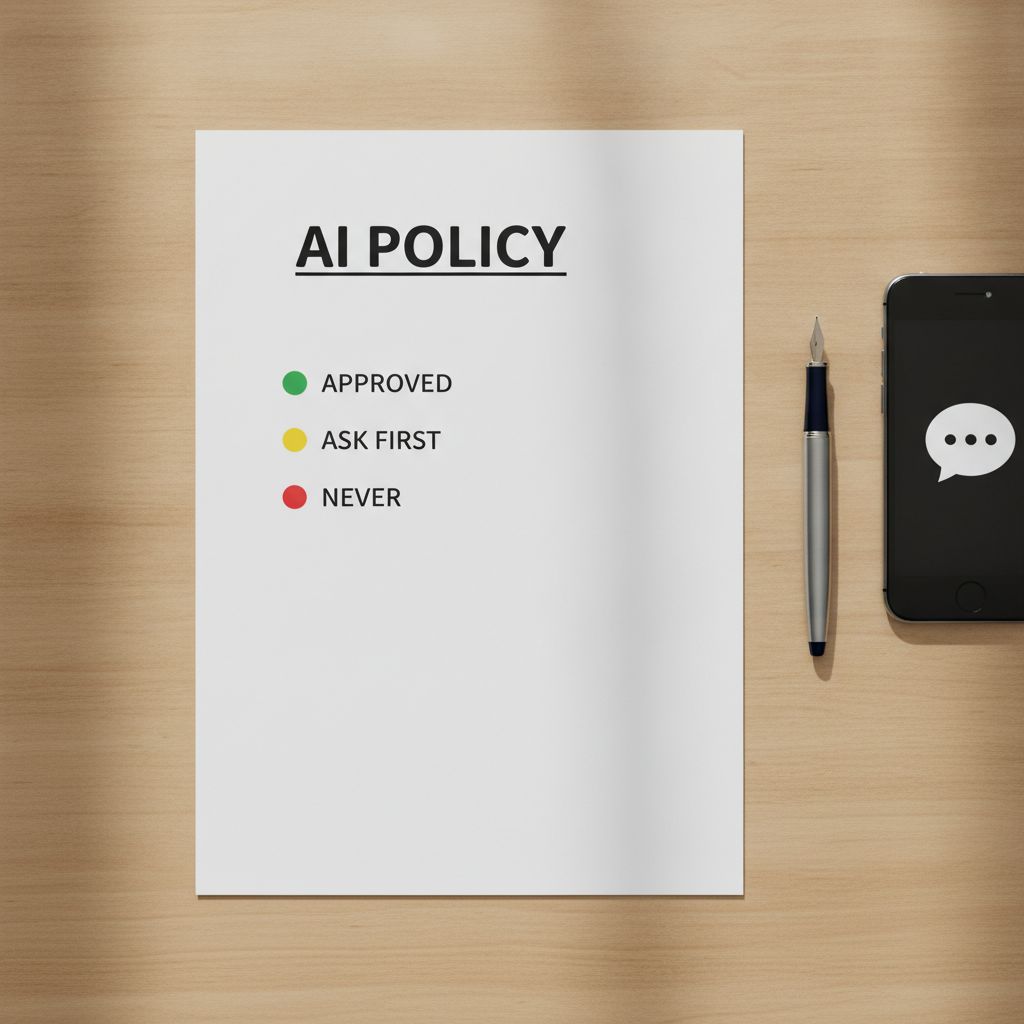
It answers three questions in plain English. Which tools is the team allowed to use. What information can and cannot be pasted into them. And who looks at the output before it reaches a customer.
The simplest version is a traffic light. Green means use it freely (drafting a blog post, summarizing your own notes). Yellow means ask first (anything touching a client). Red means never, full stop (client social security numbers, signed contracts, passwords, anything financial).
Print it. Have everyone read it and sign it. Re-sign once a year.
Why this matters: only 18% of companies have a written AI policy. Putting one page in place today puts you ahead of 82% of businesses, including ones far bigger than yours. This is the rare case where the basic move is also the rare move.
2. The Shadow AI Inventory
You cannot govern a tool you cannot see. And right now your team is using tools you have never heard of.
This is not paranoia. It is math. Studies this year put the average business at 14 active AI tools, with leadership aware of only four or five. Someone signed up for a transcription app. Someone else is running customer emails through a free chatbot. None of it is malicious. All of it is a door you did not know was open.
The fix is one honest conversation. Ask every person on your team a single question: what AI tools do you use for work? Make it amnesty. Nobody is in trouble. You just want the list.
Write down every answer. Tag each one with the same traffic light from move one. Then do it again every three months, because the list grows whether you watch it or not.
This costs you one team meeting and zero dollars, and it surfaces your biggest risk before it turns into a leak.
3. The Human-in-the-Loop Checkpoint
This is the one that saves you from the expensive mistake.
Every costly AI failure in the news shares one detail. No human checked the output before it shipped. The lawyers did not read the cases. The retailer did not verify the specs. The machine was confident, and confident is not the same as correct.
So make one rule, and make it boring: AI drafts, a human approves. For anything that touches a customer or touches money, a named person signs off before it leaves the building.
Name the approver by type. Proposals get approved by you. Customer emails get a second set of eyes from your ops lead. Anything with a legal or financial number in it gets a real review, not a skim.
One human checkpoint kills the most expensive failure mode there is, which is wrong information going out into the world with your name attached to it.
The whole net, in one breath
Write the rules (move one). See the field (move two). Catch the costly mistake before it ships (move three). Then assign one person to own it and spend 30 minutes reviewing it every quarter.
That is it. That is the system. Not a budget, not a lawyer, not a wait for the regulators. The same discipline that keeps your books clean is the discipline that keeps your AI from becoming a liability.
You already know how to do this. You have just been doing it for money instead of machines.
This week’s nudge: Pick one. Just move one. Block 30 minutes, write the one-page policy, get the team to sign it. You will be ahead of 82% of businesses before lunch.
Run the system. The system runs the business.